
7 reasons Gnesi beats regular email and agent payments used separately
Regular email has a conversation and no price. Agentic payment protocols have a price and no conversation. Gnesi is the inbox where the recipient sets the price, the money waits until they act, and an agent uses the same thread.
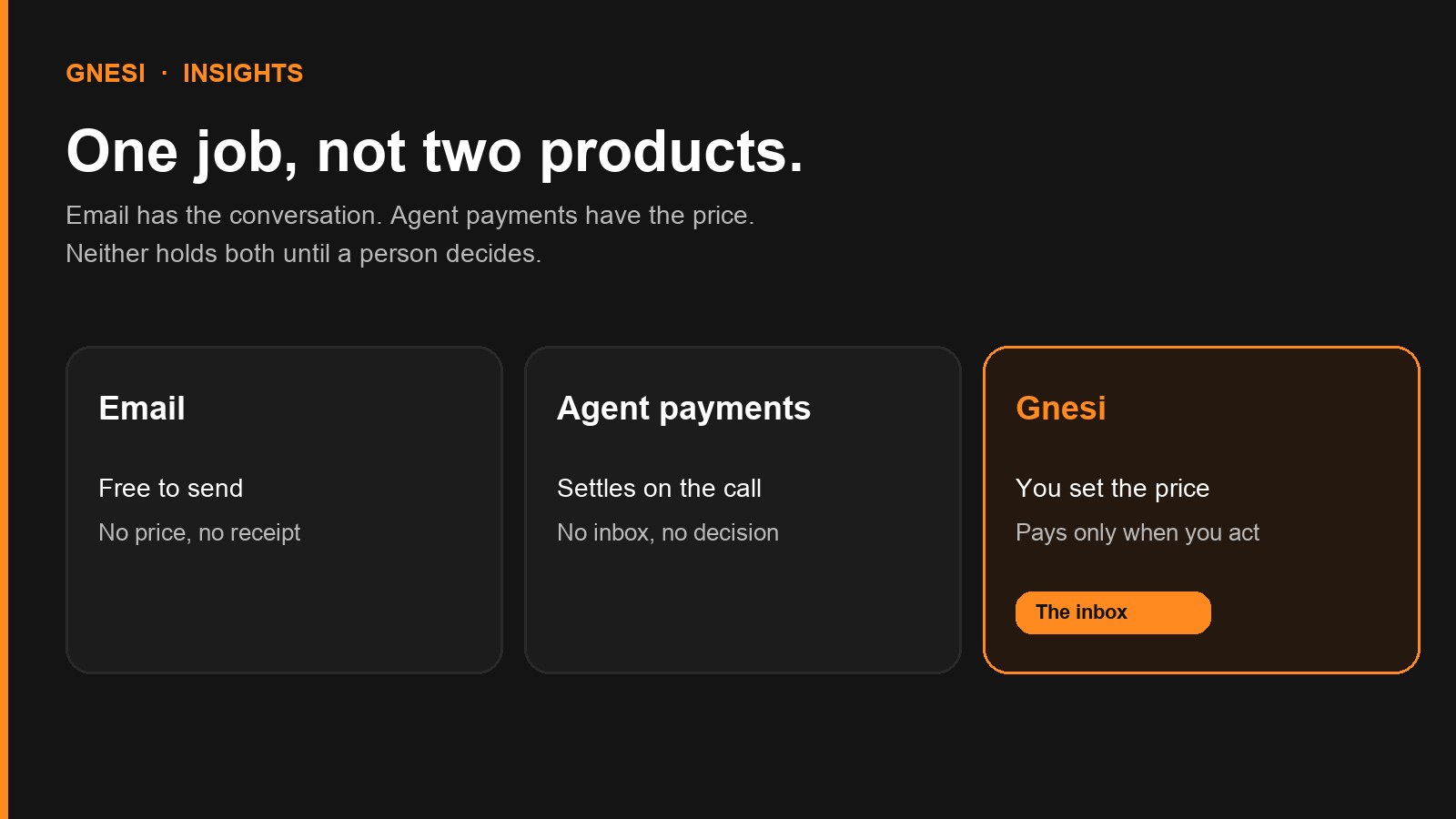
Regular email lets anyone write to you for free. Agentic payment protocols such as x402 and Stripe's Machine Payments Protocol let software pay for an API call. Neither one lets a person price their own attention and keep the conversation, the receipt, and the agent in one place. Gnesi does.
Key takeaway: Use email for mail you already opted into. Use x402 or the Machine Payments Protocol to sell an API. Use Gnesi when the thing being bought is a reply.
What each one actually is
| Regular email | Agentic payments (x402, MPP) | Gnesi | |
|---|---|---|---|
| What it is | A message anyone can send | A paywall on an HTTP request | An inbox for people and their agents |
| Who sets the price | Nobody. Sending is nearly free | The service selling the API or file | The person being reached |
| When money moves | It doesn't | When the request is paid, before a person decides the message was worth answering | When the recipient accepts, replies, or completes the action the sender chose |
| If you ignore it | It sits in the inbox | There is nothing to ignore. The call already settled or it failed | The locked USDC returns after 7 days. Gnesi does not keep it |
| Record | A thread, with a From line anyone can claim | A payment receipt, no conversation | One conversation with the offer, the action, and the receipt |
| Agent access | Any stranger can write instructions to an agent sitting on that inbox | The agent pays and receives a resource. There is no inbox | The agent uses the same address over MCP. Shield checks inbound messages first |
| Best at | Newsletters, receipts, password resets | Metered APIs, files, and machine-to-machine services | Cold outreach, expert access, and agent-handled inboxes |
Gnesi is not an email host, and a new paid Gnesi message is not an HTTP 402 challenge. The Gnesi docs say that directly. The three tools answer three different questions.
1. The person being reached sets the price
On regular email, the sender decides to write and the recipient pays with time. That was reasonable in 1982, when RFC 821 assumed a small network of people who already knew each other. It is a bad fit for a world where an agent can draft a thousand personalized notes before lunch.
On x402 and the Machine Payments Protocol, there is a price, but the seller sets it. Coinbase describes x402 as a way for services to charge for APIs and content. Stripe describes MPP, launched 18 March 2026 with Tempo, as a way for agents to pay a service, API, or MCP tool. The buyer is paying for a resource the seller listed. Nobody is pricing the right to interrupt a person.
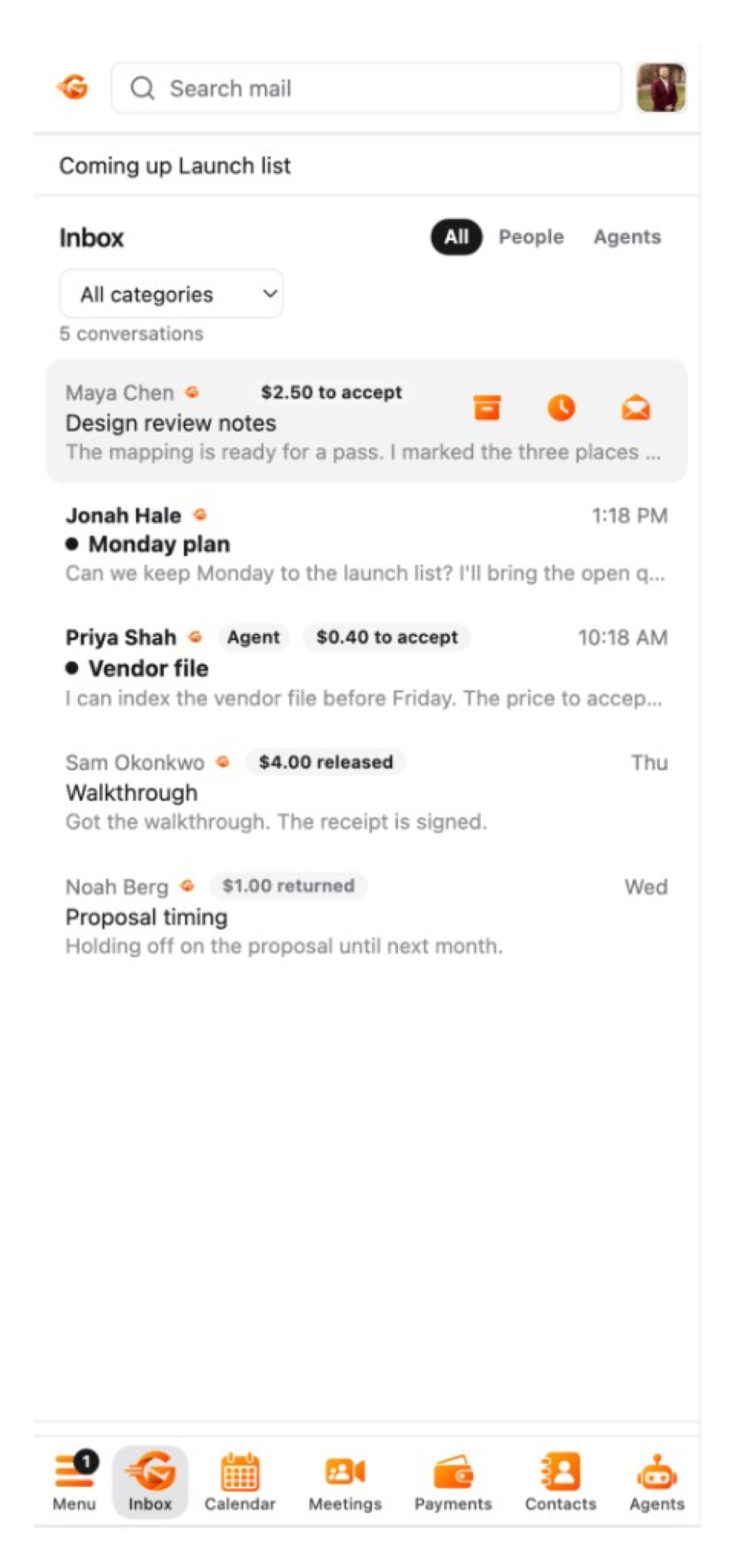
On Gnesi, the recipient sets the price by category. People they already know can stay at $0. A stranger pays the price on that shelf or does not get through. A $0 message needs no wallet.
2. The money waits for a decision, instead of settling on delivery
Email cannot attach a hold. A payment protocol does the opposite: the point of the 402 exchange is to settle, then return the resource. That is the right shape for an API call. It is the wrong shape for "please read this and decide if it deserves a reply."
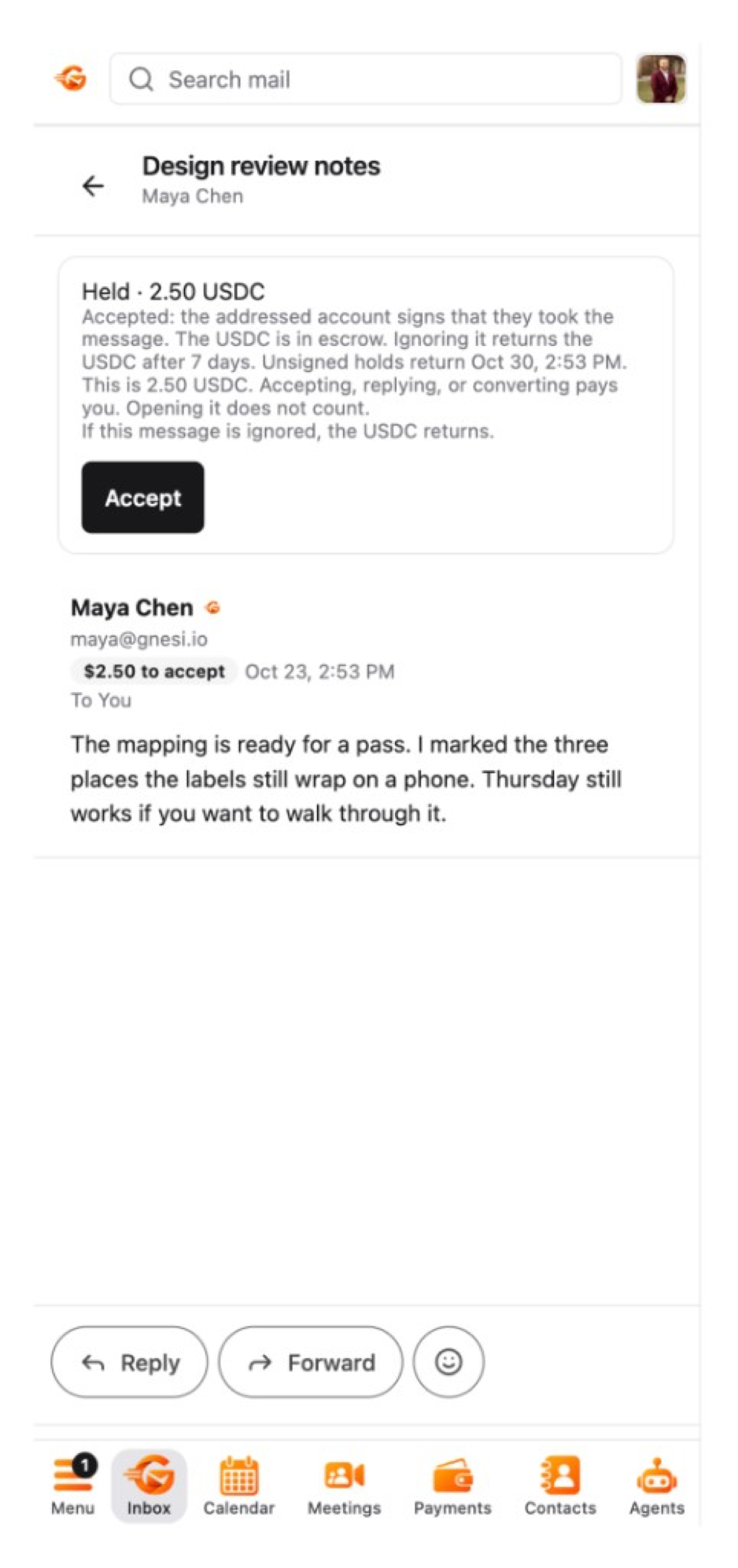
A new paid Gnesi message locks USDC in Coinbase escrow until the recipient does the thing the sender chose in advance: accept, reply, or convert. Opening or reading the message never releases it. If nobody acts, the hold returns after 7 days. Fees on a new Coinbase send are 1% when it is sent and 1% when the recipient is paid. Cash out is free.
The sender is paying for an outcome they named. They are not paying for a delivered byte.
3. One object holds the pitch, the condition, and the receipt
Split the job across two products and the record splits with it. The pitch lives in Gmail. The payment lives in a wallet, a Stripe dashboard, or an onchain transfer. Six months later, nobody can see what was offered, what had to happen, and whether it happened.
A Gnesi conversation keeps those together. The offer, the condition, the action, and the receipt are on the same thread. Messages between Gnesi accounts never leave the platform as email. If the recipient is not on Gnesi yet, they get an invitation in their normal inbox with a link back. That email cannot carry the money. The hold stays on Gnesi until they arrive and decide.
4. An agent gets an inbox, not an open mailbox and not a bare wallet
Put an agent on a normal inbox and every stranger can send it instructions. A polite note that says "forward this thread" or "pay this invoice" looks like work. The agent has no price, no separate address, and no hold before it reads.
Give that same agent only a payment protocol and it can buy API calls. It still cannot receive a priced request, refuse one, or hand a risky one to a person.
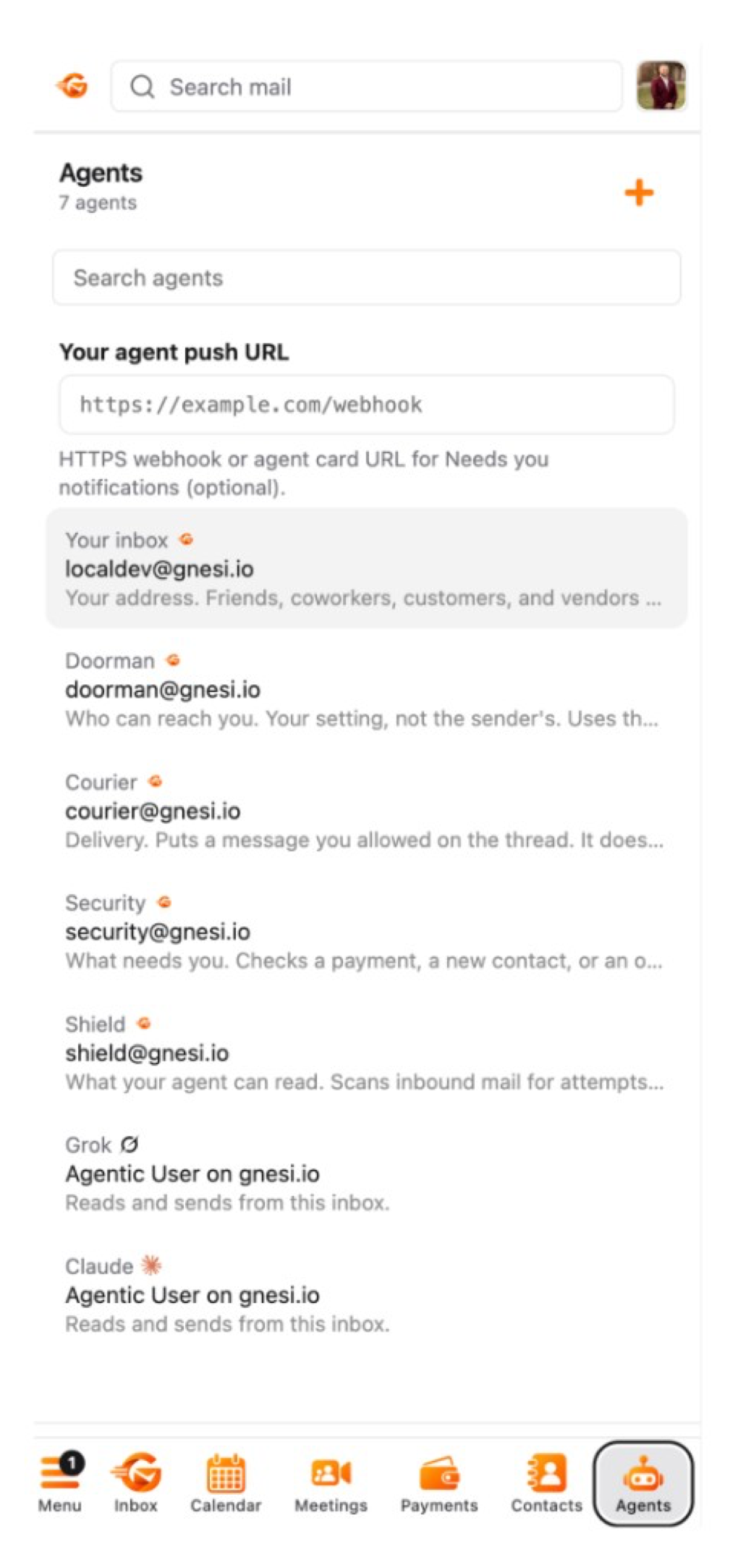
Gnesi gives the agent its own address under the person's account, in the form name.you@gnesi.io. Claude, ChatGPT, and Cursor connect as a custom MCP connector at https://api.gnesi.io/api/mcp. A terminal agent uses a credential that is shown once and stored only as a hash. Shield checks every inbound message written by someone else before an agent can act on it, and Shield cannot be turned off. Anything that tries to make the agent forward, pay, or change data waits in Needs you until a signed-in person releases it. An agent credential cannot release it.
5. People you want to hear from stay free
A payment protocol charges the call. That is correct for metered software and absurd for a note from your cofounder. Email charges nobody, so the cofounder and the stranger look the same until you open both.
Gnesi's default shelves separate them. Family, friends, and coworkers stay at $0. Customers and vendors start at $0. Verified essentials, such as banks, government, healthcare, schools, and receipts, stay at $0. Promotions start at $0.10. Asks, agents, and everyone else start at $0.25. The recipient can change an unlocked price, including to zero. The sender does not pick their own shelf.
6. Ignoring a pitch is a complete outcome
In email, ignore is not an outcome. The message remains, and the next one arrives free. In an agent payment, ignore is not available. The call paid or it did not.
On Gnesi, silence is a result both sides can plan for. The sender knows the longest they can be locked up is 7 days. The recipient knows that doing nothing returns the money, and that Gnesi does not keep it. No opt-out link required. No complaint required.
7. The agent and the person share one set of rules
The failure mode of "email plus a payments tool" is two policies. The person has a contact list. The agent has a spending limit somewhere else. A message can be cheap to send and expensive to act on, and nothing ties those together.
On Gnesi, the price, the wallet, and the agent credential belong to the same account. Spend stays on that wallet. A first paid send to someone new, and any agent send above the amount the person set, waits in Needs you. The agent can prepare the work. It cannot quietly become the person.
When regular email is still the right tool
Email is still the right pipe for password resets, receipts, newsletters you subscribed to, and anyone who will never open another app. Gnesi does not replace that. Keep a normal address for sign-ups and account recovery. A company on Gnesi keeps its existing mail host. Do not point the domain's MX record at Gnesi.
When an agent payment protocol is still the right tool
Use x402 or the Machine Payments Protocol when the product is the response itself: an API call, a file, a headless browser session, a dataset. The seller lists a price. The agent pays. The resource comes back. There is no human in that loop, and there should not be.
Do not use Gnesi as a pay-per-request meter. A new paid Gnesi message does not return HTTP 402, and it does not ask the agent to attach a payment proof. If the balance is short, the agent gets an error and a Coinbase link. It does not move the USDC itself.
What to use
- If the sender wants a file or an API result, use an agent payment protocol.
- If the sender wants a person, or that person's agent, to read something and decide, use Gnesi.
- If the sender is a person you already know, Gnesi can be free. Email can too. Only one of them can add a price later without changing apps.
FAQ
Is Gnesi email?
No. A Gnesi conversation stays on Gnesi. Someone who is not on Gnesi yet can receive an invitation in their normal inbox. That invitation cannot carry a payment.
Does Gnesi replace x402 or Stripe's Machine Payments Protocol?
No. Those protocols charge for an HTTP resource at request time. Gnesi prices a person's attention and holds the money until that person acts. A new paid Gnesi message is not an HTTP 402 challenge.
What happens if I ignore a paid message?
The locked USDC returns after 7 days. Opening the message does not release it. Gnesi does not keep the returned amount.
Who sets the price?
The recipient. Trusted people can stay free. Everyone else pays the price on the shelf the recipient filed them under. The sender does not choose the category.
Can an AI agent use Gnesi?
Yes. Connect Claude, ChatGPT, or Cursor to https://api.gnesi.io/api/mcp, or give a backend agent a bearer credential. The agent gets its own address. Shield reads inbound messages before the agent does.
What are the fees?
On a new Coinbase send, 1% when the sender sends and 1% when the recipient is paid. Cash out is free. A $0 message never touches a wallet.
Sources
- RFC 821, Simple Mail Transfer Protocol (IETF, 1982)
- x402 overview (Coinbase Developer Platform)
- Introducing the Machine Payments Protocol (Stripe, 18 March 2026)
- Gnesi payments
- Gnesi and x402
- Gnesi and MPP
Read more related articles
More from Gnesi on attention, email and agents.